Know what to ask your healthcare provider
Planning a few questions in advance can help you get the information you need and make the most of your time with your healthcare provider when discussing YEZTUGO.

All people featured on this page are actor portrayals.
All people featured on this page are actor portrayals.

You might be new to PrEP or just exploring your options. Either way, YEZTUGO® starts with something important: a conversation with your healthcare provider to see if it is right for you.
When you’re open about your sexual health with your healthcare provider, they can help you stay better protected.
Since YEZTUGO isn’t available at retail pharmacies, your provider may have it at their office or get it a different way, like through a specialty pharmacy.
Planning a few questions in advance can help you get the information you need and make the most of your time with your healthcare provider when discussing YEZTUGO.





Many people may pay as little as $0 for YEZTUGO through the Gilead Advancing Access® Co-pay Savings Program.*
*Eligibility and terms apply.


YEZTUGO, how to get started, and what the process could look like. We'll break it down step by step, so you know how it works from day one.
TEXT ON-SCREEN:
WELCOME
By prescription only. Please see Important Safety Information about YEZTUGO® throughout the video and see the Important Facts at Yeztugo.com, including an important warning about the risk of resistance from undetected HIV-1 infection. Ask your healthcare provider if YEZTUGO is right for you.
ANNOUNCER:
Welcome! This video will give you an overview of YEZTUGO. Please see Important Safety Information throughout the video, and see the YEZTUGO Important Facts, including important warnings.
TEXT ON-SCREEN:
YEZTUGO® is a prescription medicine used as HIV-1 PrEP (pre-exposure prophylaxis) to reduce the risk of getting HIV-1 in adults and adolescents who weigh at least 77 pounds. You must be HIV negative before and while receiving YEZTUGO. Talk to your healthcare provider to see if it’s right for you.
By prescription only.
ANNOUNCER:
YEZTUGO® is a prescription medicine used as HIV-1 PrEP (pre-exposure prophylaxis) to reduce the risk of getting HIV-1 in adults and adolescents who weigh at least 77 pounds. You must be HIV negative before and while receiving YEZTUGO. Talk to your healthcare provider to see if it’s right for you.
TEXT ON-SCREEN:
By prescription only. Please see Important Facts about YEZTUGO, including important warnings, at YEZTUGO.com. Ask your healthcare provider if YEZTUGO is right for you.
ANNOUNCER:
Each experience may be a bit different, but let’s dive in and see what a typical YEZTUGO journey could look like.
TEXT ON-SCREEN:
THE YEZTUGO CONVERSATION AND DECISION
ANNOUNCER:
Chapter 1: The YEZTUGO conversation and decision
TEXT ON-SCREEN:
Discussion
ANNOUNCER:
Step 1 is talking to your healthcare provider to see if YEZTUGO is right for you.
TEXT ON-SCREEN:
Medical history, All medications, Sexual health, If you are pregnant or plan to become pregnant, If you breastfeed, Past HIV and STI test results
ANNOUNCER:
They’ll ask you about your medical history, any prescription or over-the-counter medications you may take—including vitamins and supplements—your sexual health, whether you’re pregnant, planning to become pregnant, or breastfeeding, and any past HIV and STI test results. Be open and honest—they’re here to help.
TEXT ON-SCREEN:
Who should not receive or take YEZTUGO? Do not receive YEZTUGO if you already have HIV or do not know your HIV status. If you have HIV, you will need to take other medicines to treat it. YEZTUGO is not approved to treat HIV and is only for reducing the risk of getting HIV before you get it.
ANNOUNCER:
Who should not receive or take YEZTUGO? Do not receive YEZTUGO if you already have HIV or do not know your HIV status. If you have HIV, you will need to take other medicines to treat it. YEZTUGO is not approved to treat HIV and is only for reducing the risk of getting HIV before you get it.
TEXT ON-SCREEN:
What should I tell my healthcare provider before receiving YEZTUGO? • All your medical conditions. • If you are pregnant or plan to become pregnant. Tell your healthcare provider if you become pregnant while or after receiving YEZTUGO. • If you are breastfeeding or plan to breastfeed. Talk to your healthcare provider about the best way to feed your baby while you are receiving YEZTUGO. • All the medicines you take, including prescription and over-the-counter medicines, vitamins, and herbal supplements. YEZTUGO can remain in your body for up to 9 months after your last injection and can affect other medicines. Keep a list of all your medicines and show it to your healthcare provider and pharmacist. Do not start a new medicine without telling your healthcare provider.
ANNOUNCER:
What should I tell my healthcare provider before receiving YEZTUGO? • All your medical conditions. • If you are pregnant or plan to become pregnant. Tell your healthcare provider if you become pregnant while or after receiving YEZTUGO. • If you are breastfeeding or plan to breastfeed. Talk to your healthcare provider about the best way to feed your baby while you are receiving YEZTUGO. • All the medicines you take, including prescription and over-the-counter medicines, vitamins, and herbal supplements. YEZTUGO can remain in your body for up to 9 months after your last injection and can affect other medicines. Keep a list of all your medicines and show it to your healthcare provider and pharmacist. Do not start a new medicine without telling your healthcare provider.
TEXT ON-SCREEN:
N/A
ANNOUNCER:
If you and your healthcare provider decide that YEZTUGO might be an option for you...
TEXT ON-SCREEN:
HIV TEST
ANNOUNCER:
…they’ll ask you to complete and HIV test.
TEXT ON-SCREEN:
HIV-NEGATIVE RESULTS
ANNOUNCER:
YEZTUGO is only for people who are HIV negative, and is used to reduce the risk of getting HIV-1.
TEXT ON-SCREEN:
NEGATIVE
ANNOUNCER:
If the result is negative, they’ll prescribe YEZTUGO and begin the process for you to receive it.
TEXT ON-SCREEN:
IMPORTANT SAFETY INFORMATION
What is the most important information I should know about YEZTUGO?
Before and while receiving YEZTUGO:
ANNOUNCER:
IMPORTANT SAFETY INFORMATION
What is the most important information I should know about YEZTUGO?
Before and while receiving YEZTUGO:
TEXT ON-SCREEN:
IMPORTANT SAFETY INFORMATION
What is the most important information I should know about YEZTUGO?
Before and while receiving YEZTUGO:
ANNOUNCER:
YEZTUGO is not approved to treat HIV. You must immediately take other medicines if you get HIV. If you have HIV and only receive YEZTUGO, your HIV may become harder to treat. •Follow the YEZTUGO dosing schedule, which includes returning to a healthcare provider for your scheduled injections every 6 months. Missing scheduled injections or tablets can increase your chances of getting HIV. •To further help reduce your risk of getting HIV: •Know your HIV status and the HIV status of your partner(s). If they are living with HIV, your risk of getting HIV is lower if they are taking effective HIV treatment. •Talk to your healthcare provider about all the ways to help reduce the risk of getting HIV.
TEXT ON-SCREEN:
Additional Steps
ANNOUNCER:
Your healthcare provider will have some additional steps they need to take to make sure you can get the medication—let’s talk about that.
TEXT ON-SCREEN:
COVERAGE & APPROVAL
ANNOUNCER:
Chapter 2: Coverage and approval
TEXT ON-SCREEN:
Benefits Verification, Prior Authorization
ANNOUNCER:
After your healthcare provider prescribes YEZTUGO, there are 2 steps they may take—benefits verification and prior authorization.
TEXT ON-SCREEN:
Benefits verification is when a healthcare provider checks if insurance covers a prescription.
ANNOUNCER:
Benefits verification means checking if your insurance will cover a medication, like YEZTUGO. This step typically takes about 1 to 3 days.
TEXT ON-SCREEN:
Prior authorization is when an insurance company requests additional information from a healthcare provider to determine medication coverage.
ANNOUNCER:
Prior authorization is when an insurance company requests additional information from a healthcare provider to determine medication coverage.
TEXT ON-SCREEN:
Process may take about 14 to 28 days
ANNOUNCER:
Your healthcare provider will gather the list of requirements for this step. This process may take a little longer, sometimes between 14 to 28 days.
TEXT ON-SCREEN:
N/A
ANNOUNCER:
You can reach out to your healthcare provider’s office if you have questions about either of these steps.
TEXT ON-SCREEN:
ADVANCING ACCESS®
ANNOUNCER:
If you have questions about insurance coverage or financial support options, Gilead Advancing Access may be able to help. They can help you understand your coverage and financial support options.
TEXT ON-SCREEN:
PrEP.AdvancingAccess.com
ANNOUNCER:
Visit PrEP.AdvancingAccess.com to learn more.
TEXT ON-SCREEN:
GETTING YEZTUGO
ANNOUNCER:
Chapter 3: Getting YEZTUGO
TEXT ON-SCREEN:
N/A
ANNOUNCER:
Once the prior authorization is approved, your healthcare provider will work with you on getting started with YEZTUGO.
TEXT ON-SCREEN:
N/A
ANNOUNCER:
YEZTUGO must be injected in a medical setting by a healthcare professional.
TEXT ON-SCREEN:
HEALTHCARE PROVIDER
ANNOUNCER:
So talk with your healthcare provider about where you’ll get the injection.
TEXT ON-SCREEN:
HEALTHCARE PROVIDER
ANNOUNCER:
It might be at their office or at another location.
TEXT ON-SCREEN:
N/A
ANNOUNCER:
The way your healthcare provider gets the medication may vary depending on the office.
TEXT ON-SCREEN:
N/A
ANNOUNCER:
If they prescribe YEZTUGO through a specialty pharmacy...
TEXT ON-SCREEN:
SPECIALTY PHARMACY The specialty pharmacy will reach out to you or your healthcare provider about payment and delivery.
ANNOUNCER:
...the specialty pharmacy will reach out to you or your healthcare provider about payment and delivery.
TEXT ON-SCREEN:
Be sure to confirm the address where you’ll be given your YEZTUGO injections.
ANNOUNCER:
Be sure to confirm with the specialty pharmacy the address where you’ll be given your YEZTUGO injections.
TEXT ON-SCREEN:
HEALTHCARE PROVIDER, SPECIALTY PHARMACY
ANNOUNCER:
If you don’t know the address, ask your healthcare provider’s office.
TEXT ON-SCREEN:
HEALTHCARE PROVIDER, SPECIALTY PHARMACY
ANNOUNCER:
Your healthcare provider will work with the specialty pharmacy to make sure that YEZTUGO is shipped, received, and ready. They will also reach out to you about scheduling your next injection.
TEXT ON-SCREEN:
Delivery of YEZTUGO can take about 30 days once a prescription is ordered.
ANNOUNCER:
Delivery of YEZTUGO can take about 30 days once a prescription is ordered.
TEXT ON-SCREEN:
ADVANCING ACCESS®
ANNOUNCER:
After the YEZTUGO prescription is written, Gilead Advancing Access can help you navigate the next steps.
TEXT ON-SCREEN:
IT TAKES 2
ANNOUNCER:
Chapter 4: It takes 2
TEXT ON-SCREEN:
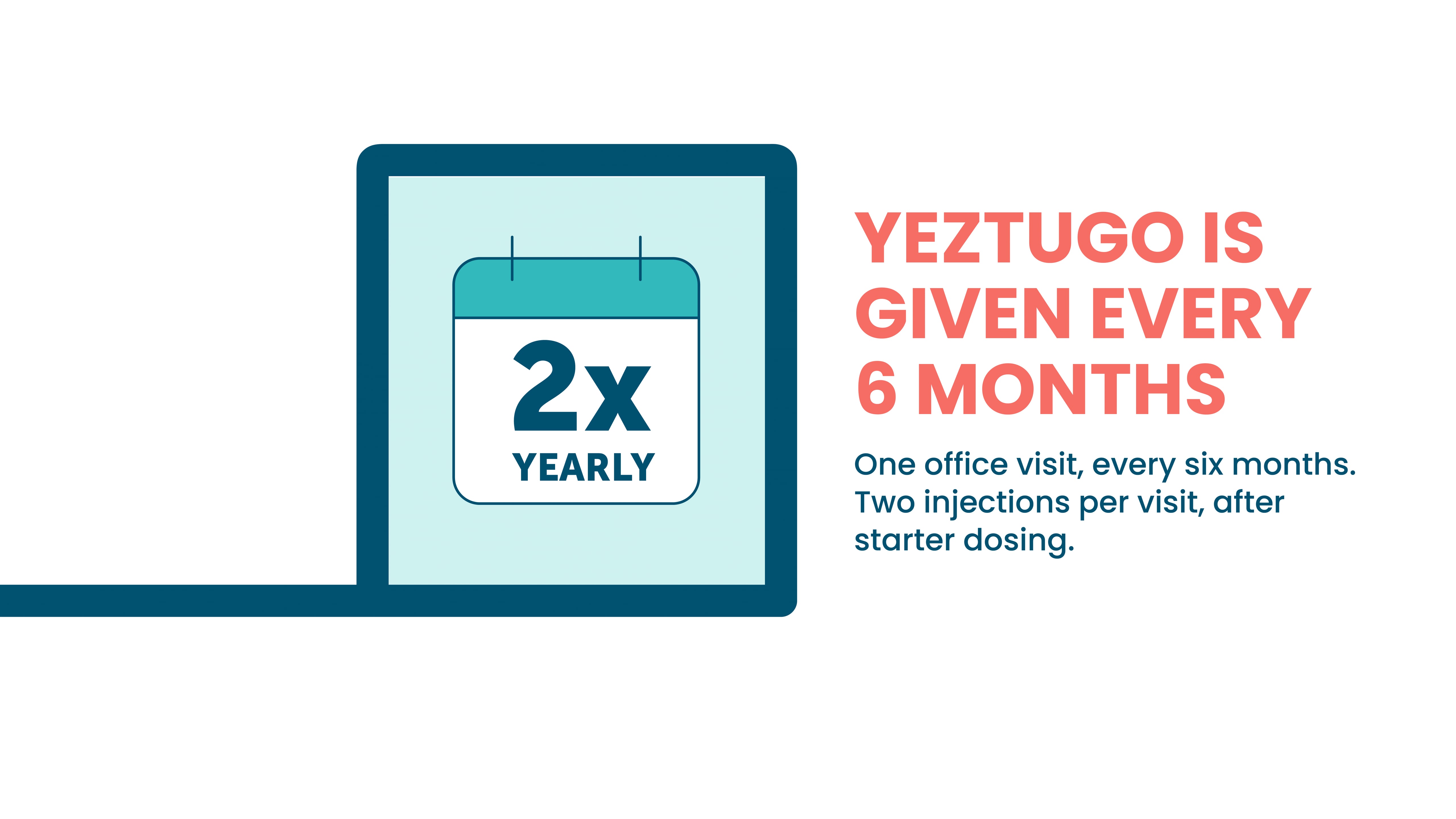
2X YEARLYYEZTUGO IS GIVEN EVERY 6 MONTHS One office visit, every six months. Two injections per visit, after starter dosing.
ANNOUNCER:
YEZTUGO is given every 6 months.
TEXT ON-SCREEN:
APPT. DAY BRING YOUR MEDICAL INSURANCE AND PRESCRIPTION INSURANCE INFORMATION
ANNOUNCER:
On the day of your appointment, it’s important to bring your health insurance and prescription insurance information with you.
TEXT ON-SCREEN:
1st YEZTUGO APPOINTMENT YOUR FIRST YEZTUGO APPOINTMENT INCLUDES AN ORAL STARTER DOSE
ANNOUNCER:
Your first appointment for YEZTUGO will include a starter dose, which is only taken when you’re first starting YEZTUGO.
TEXT ON-SCREEN:
YEZTUGO STARTER DOSING
DAY 1 in office 2 pills + 2 injections 600 mg orally (2 x 300-mg tablets) 927-mg subcutaneous injection (2 x 1.5-mL injections)
DAY 2 at home 2 pills only 600 mg orally (2 x 300-mg tablets)
ANNOUNCER:
On your first day with YEZTUGO, you’ll take a starter dose which includes two pills taken by mouth, and receive two injections of YEZTUGO at your healthcare provider’s office. This is followed by two more pills taken at home the next day.
TEXT ON-SCREEN:
REMEMBER TO TAKE THOSE LAST 2 PILLS
ANNOUNCER:
Make sure you remember to take those last 2 pills the day after your injection, as the medication needs to be taken exactly as prescribed. Talk to your healthcare provider if you have any questions about taking YEZTUGO.
TEXT ON-SCREEN:
After YEZTUGO is injected it stays under the skin and slowly releases over time. Some people may see or feel a bump at the injection site while others may not. YEZTUGO works regardless.
ANNOUNCER:
After YEZTUGO is injected it stays under the skin and slowly releases over time. Some people may see or feel a bump at the injection site while others may not. YEZTUGO works regardless.
TEXT ON-SCREEN:
What are the possible side effects of YEZTUGO?
The most common side effects of YEZTUGO are injection site reactions, headache, and nausea. These are not the only possible side effects. •Reactions at the injection site may include a lump or bump, pain, skin hardening, swelling, itching, redness, bruising, or warmth.•Rarely, if YEZTUGO is injected incorrectly, serious injection site reactions, like severe damage of the skin or open sores, can occur. Tell your healthcare provider if you have any injection site reactions or other side effects that bother you or don’t go away.
ANNOUNCER:
What are the possible side effects of YEZTUGO?
The most common side effects of YEZTUGO are injection site reactions, headache, and nausea. These are not the only possible side effects. •Reactions at the injection site may include a lump or bump, pain, skin hardening, swelling, itching, redness, bruising, or warmth.•Rarely, if YEZTUGO is injected incorrectly, serious injection site reactions, like severe damage of the skin or open sores, can occur. Tell your healthcare provider if you have any injection site reactions or other side effects that bother you or don’t go away.
TEXT ON-SCREEN:
STAYING ON SCHEDULE WITH YEZTUGO
ANNOUNCER:
Chapter 5: Staying on schedule with YEZTUGO
TEXT ON-SCREEN:
2X YEARLY Staying on schedule is key to HIV prevention with YEZTUGO. One office visit, every six months. Two injections per visit, after starter dosing.
ANNOUNCER:
Staying on schedule is key to HIV prevention with YEZTUGO.
TEXT ON-SCREEN:
2-WEEK WINDOW
ANNOUNCER:
Each dose of 2 injections is scheduled with your healthcare provider up to 2 weeks before or 2 weeks after your 6-month mark—meaning 6 months or 26 weeks after your last injections. It’s important to attend all appointments with your healthcare provider.
TEXT ON-SCREEN:
N/A
ANNOUNCER:
HIV prevention requires regular HIV testing.
TEXT ON-SCREEN:
STAYING ON YOUR 6-MONTH YEZTUGO SCHEDULE REQUIRES REGULAR HIV TESTING AND NEGATIVE RESULTS
ANNOUNCER:
To stay on your 6-month YEZTUGO schedule, your healthcare provider will require a negative HIV test before each injection and additionally as needed. Talk with them to learn more.
TEXT ON-SCREEN:
You must be HIV negative before you start and while receiving YEZTUGO. Get an HIV test before starting, before each injection, and when your healthcare provider tells you. If you think you were exposed to HIV while receiving YEZTUGO, talk to your healthcare provider as you may need an HIV test.
ANNOUNCER:
You must be HIV negative before you start and while receiving YEZTUGO. Get an HIV test before starting, before each injection, and when your healthcare provider tells you. If you think you were exposed to HIV while receiving YEZTUGO, talk to your healthcare provider as you may need an HIV test.
TEXT ON-SCREEN:
N/A
ANNOUNCER:
They’ll also use those test results as part of the paperwork they send to your insurance company.
TEXT ON-SCREEN:
That’s it!
ANNOUNCER:
And that’s it! Please refer to this video from time to time if you need a refresher. For any other questions, talk to your healthcare provider.
TEXT ON-SCREEN:
If you have questions about insurance coverage or financial support options, visit Prep.AdvancingAccess.com to learn more.
Gilead Advancing Access lock up. PrEP.AdvancingAccess.com
ANNOUNCER:
If you have questions about insurance coverage or financial support options, visit Prep.AdvancingAccess.com to learn more.
TEXT ON-SCREEN:
What is YEZTUGO?
YEZTUGO is a prescription medicine used as HIV-1 PrEP (pre-exposure prophylaxis) to reduce the risk of getting HIV-1 in adults and adolescents who weigh at least 77 pounds. You must be HIV negative before and while receiving YEZTUGO.
IMPORTANT SAFETY INFORMATION
What is the most important information I should know about YEZTUGO?
Before and while receiving YEZTUGO:
You must be HIV negative before you start and while receiving YEZTUGO. Get an HIV test before starting, before each injection, and when your healthcare provider tells you. If you think you were exposed to HIV while receiving YEZTUGO, talk to your healthcare provider as you may need an HIV test.
ANNOUNCER:
What is YEZTUGO?
YEZTUGO is a prescription medicine used as HIV-1 PrEP (pre-exposure prophylaxis) to reduce the risk of getting HIV-1 in adults and adolescents who weigh at least 77 pounds. You must be HIV negative before and while receiving YEZTUGO.
IMPORTANT SAFETY INFORMATION
What is the most important information I should know about YEZTUGO?
Before and while receiving YEZTUGO:
You must be HIV negative before you start and while receiving YEZTUGO. Get an HIV test before starting, before each injection, and when your healthcare provider tells you. If you think you were exposed to HIV while receiving YEZTUGO, talk to your healthcare provider as you may need an HIV test.
TEXT ON-SCREEN:
You must be HIV negative before you start and while receiving YEZTUGO. Get an HIV test before starting, before each injection, and when your healthcare provider tells you. If you think you were exposed to HIV while receiving YEZTUGO, talk to your healthcare provider as you may need an HIV test.
Some HIV tests may not detect HIV in a person who recently acquired HIV. Tell your healthcare provider if you had a flu-like illness within the last month before starting or while receiving YEZTUGO. Symptoms of new HIV infection include tiredness, fever, joint or muscle aches, headache, sore throat, vomiting or diarrhea, rash, night sweats, and/or enlarged lymph nodes in the neck or groin.
YEZTUGO does not prevent other sexually transmitted infections (STIs). Get tested for other STIs and practice safer sex by using condoms to reduce the risk of getting STIs.
YEZTUGO is not approved to treat HIV. You must immediately take other medicines if you get HIV. If you have HIV and only receive YEZTUGO, your HIV may become harder to treat.
Follow the YEZTUGO dosing schedule, which includes returning to a healthcare provider for your scheduled injections every 6 months. Missing scheduled injections or tablets can increase your chances of getting HIV.
To further help reduce your risk of getting HIV:
Know your HIV status and the HIV status of your partner(s). If they are living with HIV, your risk of getting HIV is lower if they are taking effective HIV treatment.
ANNOUNCER:
You must be HIV negative before you start and while receiving YEZTUGO. Get an HIV test before starting, before each injection, and when your healthcare provider tells you. If you think you were exposed to HIV while receiving YEZTUGO, talk to your healthcare provider as you may need an HIV test.
Some HIV tests may not detect HIV in a person who recently acquired HIV. Tell your healthcare provider if you had a flu-like illness within the last month before starting or while receiving YEZTUGO. Symptoms of new HIV infection include tiredness, fever, joint or muscle aches, headache, sore throat, vomiting or diarrhea, rash, night sweats, and/or enlarged lymph nodes in the neck or groin.
YEZTUGO does not prevent other sexually transmitted infections (STIs). Get tested for other STIs and practice safer sex by using condoms to reduce the risk of getting STIs.
YEZTUGO is not approved to treat HIV. You must immediately take other medicines if you get HIV. If you have HIV and only receive YEZTUGO, your HIV may become harder to treat.
Follow the YEZTUGO dosing schedule, which includes returning to a healthcare provider for your scheduled injections every 6 months. Missing scheduled injections or tablets can increase your chances of getting HIV.
To further help reduce your risk of getting HIV:
Know your HIV status and the HIV status of your partner(s). If they are living with HIV, your risk of getting HIV is lower if they are taking effective HIV treatment.
TEXT ON-SCREEN:
Talk to your healthcare provider about all the ways to help reduce the risk of getting HIV.
Who should not receive or take YEZTUGO?
Do not receive YEZTUGO if you already have HIV or do not know your HIV status. If you have HIV, you will need to take other medicines to treat it. YEZTUGO is not approved to treat HIV and is only for reducing the risk of getting HIV before you get it.
What are the possible side effects of YEZTUGO?
The most common side effects of YEZTUGO are injection site reactions, headache, and nausea. These are not the only possible side effects.
Reactions at the injection site may include a lump or bump, pain, skin hardening, swelling, itching, redness, bruising, or warmth.
Rarely, if YEZTUGO is injected incorrectly, serious injection site reactions, like severe damage of the skin or open sores, can occur.
Tell your healthcare provider if you have any injection site reactions or other side effects that bother you or don’t go away.
What should I tell my healthcare provider before receiving YEZTUGO?
ANNOUNCER:
Talk to your healthcare provider about all the ways to help reduce the risk of getting HIV.
Who should not receive or take YEZTUGO?
Do not receive YEZTUGO if you already have HIV or do not know your HIV status. If you have HIV, you will need to take other medicines to treat it. YEZTUGO is not approved to treat HIV and is only for reducing the risk of getting HIV before you get it.
What are the possible side effects of YEZTUGO?
The most common side effects of YEZTUGO are injection site reactions, headache, and nausea. These are not the only possible side effects.
Reactions at the injection site may include a lump or bump, pain, skin hardening, swelling, itching, redness, bruising, or warmth.
Rarely, if YEZTUGO is injected incorrectly, serious injection site reactions, like severe damage of the skin or open sores, can occur.
Tell your healthcare provider if you have any injection site reactions or other side effects that bother you or don’t go away.
What should I tell my healthcare provider before receiving YEZTUGO?
TEXT ON-SCREEN:
All your medical conditions.
If you are pregnant or plan to become pregnant. Tell your healthcare provider if you become pregnant while or after receiving YEZTUGO.
If you are breastfeeding or plan to breastfeed. Talk to your healthcare provider about the best way to feed your baby while you are receiving YEZTUGO.
All the medicines you take, including prescription and over-the-counter medicines, vitamins, and herbal supplements. YEZTUGO can remain in your body for up to 9 months after your last injection and can affect other medicines. Keep a list of all your medicines and show it to your healthcare provider and pharmacist. Do not start a new medicine without telling your healthcare provider.
You are encouraged to report negative side effects of prescription drugs to the FDA. Visit www.fda.gov/medwatch, or call 1-800-FDA-1088.
Please see Important Facts about YEZTUGO, including important warnings, at Yeztugo.com.
YEZTUGO, the YEZTUGO Logo, ADVANCING ACCESS, the ADVANCING ACCESS Logo, GILEAD, and the GILEAD Logo are trademarks of Gilead Sciences, Inc., or its related companies.
©2025 Gilead Sciences, Inc. All rights reserved.
333 Lakeside Drive, Foster City, CA 94404
US-YTGC-0141 01/26
ANNOUNCER:
All your medical conditions.
If you are pregnant or plan to become pregnant. Tell your healthcare provider if you become pregnant while or after receiving YEZTUGO.
If you are breastfeeding or plan to breastfeed. Talk to your healthcare provider about the best way to feed your baby while you are receiving YEZTUGO.
All the medicines you take, including prescription and over-the-counter medicines, vitamins, and herbal supplements. YEZTUGO can remain in your body for up to 9 months after your last injection and can affect other medicines. Keep a list of all your medicines and show it to your healthcare provider and pharmacist. Do not start a new medicine without telling your healthcare provider.
You are encouraged to report negative side effects of prescription drugs to the FDA. Visit www.fda.gov/medwatch, or call 1-800-FDA-1088.
Please see Important Facts about YEZTUGO, including important warnings, at Yeztugo.com.
TEXT ON-SCREEN:
Please see Important Facts about YEZTUGO, including important warnings, at Yeztugo.com. Ask your healthcare provider if YEZTUGO is right for you.
ANNOUNCER:
N/A
If you don’t have a healthcare provider, or want to find one who is experienced in prescribing PrEP, here's a tool that could help.




YEZTUGO is a prescription medicine used as HIV-1 PrEP (pre-exposure prophylaxis) to reduce the risk of getting HIV-1 in adults and adolescents who weigh at least 77 pounds. You must be HIV negative before and while receiving YEZTUGO.
YEZTUGO is a prescription medicine used as HIV-1 PrEP (pre-exposure prophylaxis) to reduce the risk of getting HIV-1 in adults and adolescents who weigh at least 77 pounds. You must be HIV negative before and while receiving YEZTUGO.
What is the most important information I should know about YEZTUGO?
Before and while receiving YEZTUGO:
Tap for Important Safety Information, including an important warning on the risk of drug resistance if you become HIV positive and only take YEZTUGO.
Who should not receive or take YEZTUGO?
What are the possible side effects of YEZTUGO?
What should I tell my healthcare provider before receiving YEZTUGO?
You are encouraged to report negative side effects of prescription drugs to the FDA. Visit www.fda.gov/medwatch, or call 1-800-FDA-1088.