
All people featured on this page are actor portrayals.
All people featured on this page are actor portrayals.

Your First Steps.
Once you and your healthcare provider have decided YEZTUGO is right for you, they'll work with you to help get you started. It will require a few steps to get going, but once you’re up and running it’s just a part of your year. You must be HIV negative before starting YEZTUGO and get an HIV test before every injection appointment.
YEZTUGO dosing
YEZTUGO dosing

Getting started with YEZTUGO begins with starter doses:
- 2 pills taken at your healthcare provider's office,
along with 2 injections given by your healthcare provider - 2 additional pills taken at home the next day
After your starter doses, you'll receive ongoing doses of 2 YEZTUGO injections every six months as part of your PrEP plan.
- Each dose of YEZTUGO is given as 2 injections by a healthcare provider
- The injections reach a short distance under your skin (subcutaneous) and are given in your abdomen or thigh
Starter doses are required when you begin YEZTUGO and pills should be taken as your healthcare provider tells you. Talk to them if you have any questions or concerns.

You may experience some discomfort where the injection is given. You should talk to your healthcare provider about ways to help address this, which could include the use of:
- Ice packs
- Pain relief medications
Please note, these considerations are not specific to YEZTUGO.
You are encouraged to report negative side effects of prescription drugs to the FDA.
Visit www.fda.gov/medwatch, or call 1-800-FDA-1088.
YEZTUGO is only 2 doses a year, so staying on your dosing schedule is important.
Remember, you only receive the full benefit of PrEP when you stick to your plan. Attend all your appointments and get YEZTUGO as scheduled, 1 visit every 6 months.
Sign up for Ready to Go reminders to help you stay prepared.


YEZTUGO scheduling: plan ahead to help you stay protected from HIV.
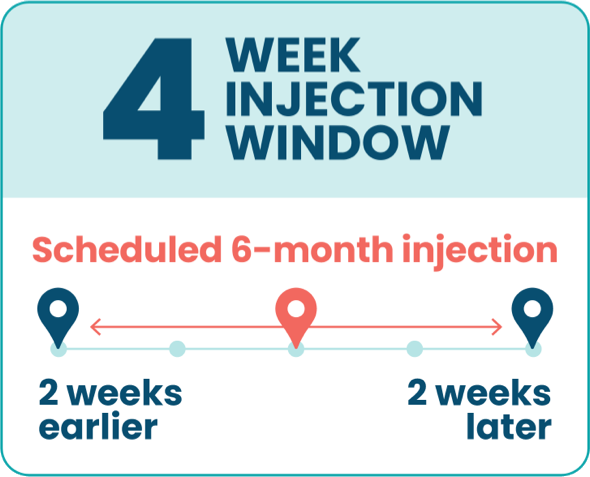
YEZTUGO is given every 6 months. Your next appointment can be scheduled up to 2 weeks before—or 2 weeks after—your 6-month mark.
- Book your next appointment as soon as you can
- Stick to your 6-month schedule—it’s just twice a year* for a full year of HIV prevention
- You’ll need a negative HIV test before every dose of YEZTUGO
*2 injections under the skin every 6 months, after starter dosing. Starter dosing includes 2 pills (2 x 300-mg
tablets) taken by mouth, along with 2
injections given at a healthcare provider's office, followed by 2 more pills taken at home the next day.
What if I think I will miss a dose?
It's important that you stick to your schedule. If you think you'll miss your 6-month appointment, talk to your healthcare provider right away to review your options and next steps.

Have you signed up yet for Ready to Go?
Ready to Go provides personalized reminders, resources, and testimonials designed to help you be prepared with YEZTUGO.


YEZTUGO is a prescription medicine used as HIV-1 PrEP (pre-exposure prophylaxis) to reduce the risk of getting HIV-1 in adults and adolescents who weigh at least 77 pounds. You must be HIV negative before and while receiving YEZTUGO.
YEZTUGO is a prescription medicine used as HIV-1 PrEP (pre-exposure prophylaxis) to reduce the risk of getting HIV-1 in adults and adolescents who weigh at least 77 pounds. You must be HIV negative before and while receiving YEZTUGO.
Important Safety Information
What is the most important information I should know about YEZTUGO?
Before and while receiving YEZTUGO:
Tap for Important Safety Information, including an important warning on the risk of drug resistance if you become HIV positive and only take YEZTUGO.
- You must be HIV negative before you start and while receiving YEZTUGO. Get an HIV test before starting, before each injection, and when your healthcare provider tells you. If you think you were exposed to HIV while receiving YEZTUGO, talk to your healthcare provider as you may need an HIV test.
- Some HIV tests may not detect HIV in a person who recently acquired HIV. Tell your healthcare provider if you had a flu-like illness within the last month before starting or while receiving YEZTUGO. Symptoms of new HIV infection include tiredness, fever, joint or muscle aches, headache, sore throat, vomiting or diarrhea, rash, night sweats, and/or enlarged lymph nodes in the neck or groin.
- YEZTUGO does not prevent other sexually transmitted infections (STIs). Get tested for other STIs and practice safer sex by using condoms to reduce the risk of getting STIs.
- YEZTUGO is not approved to treat HIV. You must immediately take other medicines if you get HIV. If you have HIV and only receive YEZTUGO, your HIV may become harder to treat.
- Follow the YEZTUGO dosing schedule, which includes returning to a healthcare provider for your scheduled injections every 6 months. Missing scheduled injections or tablets can increase your chances of getting HIV.
- To further help reduce your risk of getting HIV:
- Know your HIV status and the HIV status of your partner(s). If they are living with HIV, your risk of getting HIV is lower if they are taking effective HIV treatment.
- Talk to your healthcare provider about all the ways to help reduce the risk of getting HIV.
Who should not receive or take YEZTUGO?
- Do not receive YEZTUGO if you already have HIV or do not know your HIV status. If you have HIV, you will need to take other medicines to treat it. YEZTUGO is not approved to treat HIV and is only for reducing the risk of getting HIV before you get it.
What are the possible side effects of YEZTUGO?
- The most common side effects of YEZTUGO are injection site reactions, headache, and nausea. These are not the only possible side effects.
- Reactions at the injection site may include a lump or bump, pain, skin hardening, swelling, itching, redness, bruising, or warmth.
- Rarely, if YEZTUGO is injected incorrectly, serious injection site reactions, like severe damage of the skin or open sores, can occur.
- Tell your healthcare provider if you have any injection site reactions or other side effects that bother you or don’t go away.
What should I tell my healthcare provider before receiving YEZTUGO?
- All your medical conditions.
- If you are pregnant or plan to become pregnant. Tell your healthcare provider if you become pregnant while or after receiving YEZTUGO.
- If you are breastfeeding or plan to breastfeed. Talk to your healthcare provider about the best way to feed your baby while you are receiving YEZTUGO.
- All the medicines you take, including prescription and over-the-counter medicines, vitamins, and herbal supplements. YEZTUGO can remain in your body for up to 9 months after your last injection and can affect other medicines. Keep a list of all your medicines and show it to your healthcare provider and pharmacist. Do not start a new medicine without telling your healthcare provider.
You are encouraged to report negative side effects of prescription drugs to the FDA. Visit www.fda.gov/medwatch, or call 1-800-FDA-1088.